
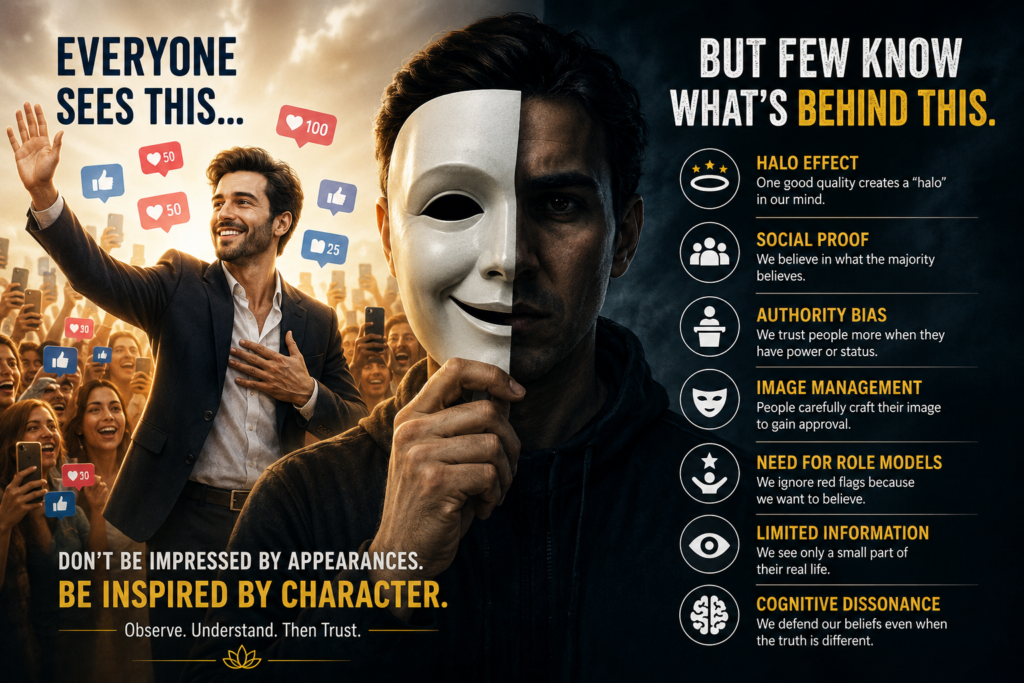
In today’s digital world, people are constantly exposed to carefully crafted images of success, kindness, intelligence, and influence. Through social media, public appearances, and community interactions, certain individuals create an impression that they are exceptionally trustworthy, admirable, and worthy of respect. Friends, relatives, followers, and even entire communities often accept these impressions without much questioning.
But why do people get attracted to such personalities so easily?
The answer lies in the way the human mind processes information and forms judgments about others.
The Power of First Impressions
Human beings are naturally wired to make quick assessments. Within seconds of meeting someone or viewing their online profile, our brains begin forming opinions. When a person appears confident, articulate, attractive, successful, or influential, we tend to assume they possess many other positive qualities as well.
This psychological tendency is known as the Halo Effect. A single positive characteristic creates a favorable overall impression, making it easier for people to overlook weaknesses or inconsistencies.
The Reality Behind Curated Images
Social media has changed the way people present themselves to the world. Most individuals showcase their achievements, happy moments, awards, vacations, and successes while keeping struggles, failures, mistakes, and vulnerabilities hidden from public view.
As a result, audiences often see a carefully curated version of reality rather than the complete picture. Over time, repeated exposure to these positive images can create an illusion of perfection.
Why Popularity Creates Trust
When thousands of people follow, admire, or praise someone, others naturally assume that the person must be trustworthy and credible.
Psychologists refer to this phenomenon as Social Proof. Human beings often rely on the behavior and opinions of others to decide what is right, safe, or acceptable. If many people support someone, our brains interpret that popularity as evidence of value and trustworthiness.
However, popularity is not always a reliable indicator of character.
The Influence of Authority
People are generally more likely to trust individuals who possess authority, expertise, wealth, status, or public recognition. A respected title, professional position, or large audience can significantly influence how others perceive them.
This tendency is called Authority Bias. While expertise and experience deserve respect, authority alone should not replace critical thinking and independent judgment.
Our Natural Desire for Heroes
Human beings have a deep psychological need for inspiration and guidance. We often seek role models who represent the values and qualities we admire. This desire helps us find motivation and hope, but it can also make us vulnerable to overlooking warning signs or inconsistencies.
When we strongly admire someone, we may unconsciously ignore information that challenges our positive perception of them.
Public Image Versus True Character
One of the most important psychological distinctions is the difference between public image and true character.
Public image is what people choose to show others.
Character is revealed through consistent actions, values, decisions, and behavior over time—especially when there is no audience watching.
Some individuals genuinely live according to the values they promote. Others may be highly skilled at creating a positive image while behaving differently in private. This is why long-term observation is often a better measure of character than popularity, influence, or public recognition.
Developing Psychological Awareness
Psychological awareness does not mean becoming suspicious of everyone. Instead, it means learning to balance admiration with critical thinking.
Before placing complete trust in someone, consider the following questions:
- Are their actions consistent with their words?
- Do they take responsibility for their mistakes?
- How do they treat people who cannot benefit them?
- Do they behave ethically when no one is watching?
- Are they respected only for their image, or also for their integrity?
These questions help us make more informed judgments and protect ourselves from being influenced solely by appearances.
The Importance of Critical Thinking in the Digital Age
In a world driven by visibility, influence, and online engagement, appearances can be powerful. However, true wisdom comes from looking beyond surface impressions and understanding the deeper aspects of human behavior.
The more we understand psychological concepts such as the Halo Effect, Social Proof, and Authority Bias, the better equipped we become to evaluate people objectively and make healthier decisions about whom we trust and follow.
Conclusion
Not everything that shines is gold, and not every admired personality is necessarily authentic. While public image can influence perception, true character reveals itself through consistency, accountability, empathy, and integrity.
Understanding the psychology behind attraction and influence helps us become more mindful observers of human behavior. Rather than being guided solely by popularity or appearance, we can learn to value authenticity, wisdom, and genuine character.
Because in the end, reputation may attract attention, but character earns lasting respect.
Author: Chandrakala Vadlamudi
Conselling Psychologist | Founder, VyANA – Energy of Well-Being
🌐 www.vyana-energy.co.in
A Thought to Reflect Upon
“Popularity may capture attention, but character earns trust.”
“An image can be created in minutes, but integrity is built over years.”
“Do not judge people by how brightly they shine in public. Judge them by how consistently they act when no one is watching.”
ముగింపు సందేశం
“మాటలు మనల్ని ఆకర్షించవచ్చు…
ఇమేజ్ మనల్ని ప్రభావితం చేయవచ్చు…
కానీ ఒక వ్యక్తి నిజమైన విలువను నిర్ణయించేది అతని నిరంతర ప్రవర్తనే.”
“ప్రజాదరణను కాదు… వ్యక్తిత్వాన్ని గమనించండి.
ప్రచారాన్ని కాదు… ప్రవర్తనను పరిశీలించండి.”
“కనిపించేది నిజం కాకపోవచ్చు…
కానీ కాలం మాత్రం నిజాన్ని తప్పకుండా బయటపెడుతుంది.”